Hydatid disease is a zoonosis caused by the tapeworm Echinococcus granulosus. Dogs act as definitive hosts for the parasite with many mammals, including ruminants and humans, acting as intermediate hosts with the formation of hydatid cysts. These can lead to offal condemnation in farm animals but more seriously can lead to significant pathology in humans with cysts forming in the bone, liver, lungs, central nervous system and heart. Hydatid disease has historically been considered to be limited in the UK to regional foci in Wales, the Welsh border, Herefordshire and the Western Isles of Scotland. There is growing evidence, however, to suggest that it is present focally in other parts of England and Scotland. Prevention of infection in dogs and exposure of humans to infective eggs from the parasite are crucial considerations when formulating parasite control plans.
E. granulosus life cycle
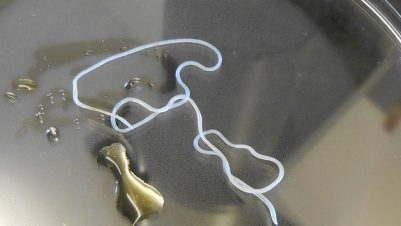
Adult tapeworms can reach 5 to 8mm long (Figure 1) and are found attached to the intestinal wall of dogs. Immediately infective eggs are passed in the faeces and ingested by the intermediate host. This leads to cyst formation in the tissues, and these cysts are then infective when ingested. While domestic canids harbour the adult tapeworms, ruminants, pigs and humans are all capable of acting as intermediate hosts. Ingestion of the cysts by dogs completes the life cycle. Several distinct genotypes of E. granulosus are recognised, with some having distinct intermediate host preferences. Not all genotypes are zoonotic, with the genotype causing most cystic echinococcosis infections in humans principally maintained in a dog–sheep life cycle. Cattle can sometimes also be involved.

Current distribution in the UK
Work carried out in abattoirs across Britain has identified positive cases which are not thought to have originated in Wales, suggesting that there are other endemic foci
The approximate distribution of E. granulosus in Europe is shown in Figure 2. E. granulosus has long been established in Wales, particularly in Powys and adjoining areas. It is also known to be present in the Western Isles of Scotland. However, work carried out in abattoirs across Britain has identified positive cases which are not thought to have originated in Wales, suggesting that there are other endemic foci. Two hunt packs were also found to be positive in England by faecal testing in 2014 (Craig, 2014).
Further evidence is emerging that the incidence of E. granulosus is much more widespread in Britain than previously thought. Data presented at this year’s BSAVA congress by Dr Marisol Collins showed evidence of E. granulosus in previously unreported areas of the UK. Of 46 sheep farms sampled, 17 percent had dogs that were positive for Echinococcus spp coproantigen, and 11 percent had dogs positive for E. granulosus copro-DNA (Collins, 2025). Positive cases were more likely to be in Wales, but cases were also found in the North East of England, Northern Ireland and eastern Scotland.
Northern Ireland has previously been thought to be free of the parasite and while these results do not confirm endemicity, they do throw its hydatid-free status into doubt. Out of 32 hunting packs, 9 percent tested positive for Echinococcus species coproantigen, with cases found in the North West and South West of England and the Scottish Borders (Collins, 2025). Four cases identified in cattle carcasses in abattoirs in Gloucestershire, Herefordshire, Staffordshire and North Yorkshire had never entered Wales.
Human cases were also discussed at the congress with Dr Laura Nabarro describing five UK-acquired human cases that were treated in 2024, compared to just two UK-acquired cases between 2006 and 2016. Although the number of cases is low, hydatid disease in humans typically has long incubation periods of years. This means an increased incidence of disease being detected now could be an indication of historical increased exposure with further increases likely to be seen in coming years. Information presented at the congress is due to be published in peer-reviewed papers over the coming year.

Signalment in dogs
Dogs tolerate the Echinococcus infection well and act as subclinical carriers of infection. Treatment and other preventative measures in dogs are not, therefore, to improve canine health, but to reduce offal condemnation for farmers and crucially to reduce zoonotic risk.
| Infection cannot be identified by clinical examination, only by diagnostic testing. |
Transmission to humans and hydatid disease
Eggs passed in dog faeces are immediately infective and may adhere to hairs around the infected dog’s anus, muzzle, fur and paws (Torgerson et al., 2003). This may lead to ingestion of eggs by people, particularly in the course of close contact with dogs. They may also contaminate wild berries, as well as fruit and vegetables grown for human domestic consumption. Contamination of drinking water from untreated sources may also present an indirect route of exposure and infection. Infection in humans can lead to significant pathology with one or more hydatid cysts located in the liver or lungs, and less frequently in the bones, kidneys, spleen, heart, muscles and central nervous system. The potential severity of the disease means that preventing human exposure to infective eggs is crucial to minimise zoonotic infection and subsequent hydatidosis.
| It is important to raise awareness among pet owners of the risks of hydatid disease and the importance of tapeworm control, while also keeping risks in perspective. The current risk of infection in the UK is still considered to be low. |
Diagnosis of E. granulosus in dogs
Echinococcus proglottids are only a few millimetres long and often break up during intestinal passage. As such, they are almost never seen in faeces. Diagnosis, therefore, relies on the detection of infection by copro-microscopic techniques or by faecal PCR. Faecal flotation is often an insensitive test (Wolfe et al., 2001), although modern techniques and AI systems are improving sensitivity. Even when eggs are detected, however, all eggs of the family Taeniidae (including Echinococcus and Taenia spp tapeworms) are indistinguishable by morphology, making it uncertain whether Taenia or Echinococcus spp are present. Faecal PCR testing is now commercially available and carries a high sensitivity and specificity. At the point of detection, shedding of infectious eggs will already be occurring, and as a result, testing and treatment are not an appropriate means of Echinococcus control in dogs.
| Diagnosis should be used for surveillance and to assess immediate and wider zoonotic risk, as well as helping in risk assessments for whether routine treatment for Echinococcus is required regionally for dogs. |
Treatment of E. granulosus in dogs
Praziquantel at 5mg/kg is highly effective at eliminating infection in dogs. If infection is diagnosed, then contaminated fur should be clipped away and disposed of in clinical waste. Contaminated environmental surfaces should be disinfected and the coat washed. PPE should be used while carrying this out. The pre-patent period for E. granulosus is six weeks, so dogs at high risk of infection should be treated every six weeks with a licensed product. Monthly treatment is acceptable to allow use of combination products for monthly Toxocara, flea, Angiostrongylus vasorum and tick treatment where this is required on the basis of a risk assessment.
| To improve compliance and reduce cost for owners, consider a parasite combination product for roundworm, lungworm and/or fleas and ticks where routine treatment of these parasites is also required. |
Prevention
A number of control measures are required to reduce zoonotic risk and the economic impact of E. granulosus tapeworms:
- Treatment with praziquantel every four to six weeks of all dogs in known hydatid endemic areas unless kept on leads and fed cooked diets
- Treatment with praziquantel every four to six weeks for any dogs outside these areas shedding Taenia tapeworm segments (the risk factors for Taenia and E. granulosus infection are broadly the same), fed raw offal/unprocessed raw diets or that have access to fallen livestock
- Praziquantel treatment at least four times a year for dogs in non-endemic areas that are out of sight off-lead with potential pasture access
- Prevention of access of dogs to ruminant carcasses and offal. Raising awareness of the risks of tapeworm infections among dog owners and encouraging them to keep pets on leads around livestock pastures is also important in reducing exposure to infection. Similarly, discouraging the feeding of raw offal and unprocessed raw diets will also reduce risk. If raw diets are fed, then processed diets where raw meat and offal ingredients have been adequately inspected and frozen will minimise transmission
- Anti-dog-fouling campaigns. Veterinary practices can promote anti-dog-fouling campaigns in their reception areas and on social media, as well as engaging with schools to raise awareness and supporting efforts by local councils
Conclusions
Despite praziquantel being highly efficacious in eliminating tapeworm infections in canines and effective meat inspection being in place across the UK, hydatid disease continues to be endemic and the incidence of disease is increasing
Despite praziquantel being highly efficacious in eliminating tapeworm infections in canines and effective meat inspection being in place across the UK, hydatid disease continues to be endemic and the incidence of disease is increasing. The risk of spread of E. granulosus to dogs throughout the UK via distribution of infected offal through abattoirs is unquantified, presenting a zoonotic risk which vets and doctors may not recognise. Increased education, surveillance and monthly deworming of dogs at high risk of tapeworm infection is vital if the zoonotic and economic impact of E. granulosus is to be controlled.